
pexels-eberhard-grossgasteiger-1743364

MIVOR – Racism in Europe (Blog Series Racism Around the World)

Since Frankfurt am Main in the heart of Europe is considered the birthplace of MIVOR, we dedicate the next part of our blog series on „Racism Around the World“ to the continent of Europe.

In a survey, 64% of the EU citizens interviewed stated that discrimination based on religion and origin is still widespread in Europe these days. A recent survey conducted by MIVOR on the subject can confirm this for Germany. In the survey we conducted, more than 35% of respondents stated that they experience discrimination on the basis of their origin or religion every month.

Why and where exactly does this kind of racism occur in Europe?

Despite legal protection instruments against racism and related forms of intolerance, minorities (in some situations the majority of EU citizens) are discriminated against on the basis of ethnic and religious viewpoints in the form of verbal and physical violence and exclusion. Whether at the workplace, when looking for a job and housing, or in everyday life, racism appears. Historically, countries in Europe such as Portugal, Spain, France, the United Kingdom and Germany are no strangers to racism. According to our survey, the reasons for racism from the point of view of EU citizens are a superior thinking of people about their origin compared to others, the fear of losing power and the fear of the stranger.

Harvard Implicit Association Test

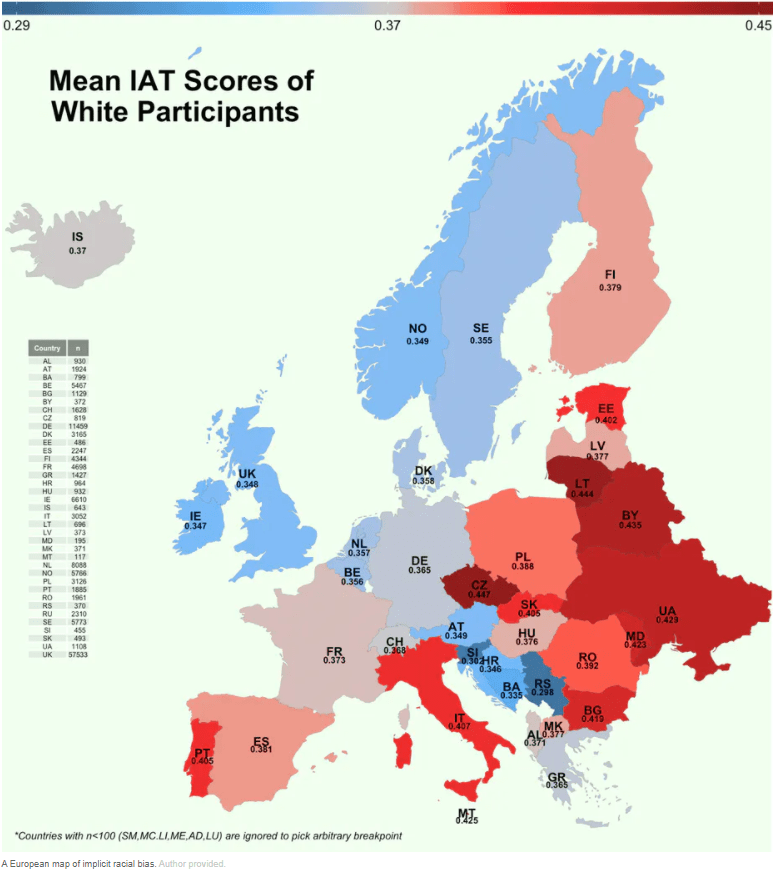
With the help of a Harvard study on the topic of racism (against dark-skinned people), a map of Europe and the USA could be generated in which it can be seen which countries show a tendency towards white or dark-skinned people. It should be noted that +1 indicates a preference for white and -1 indicates a preference for darker skinned, with a value close to 0 demonstrating less discrimination in the country. The map shows that Serbia, Slovenia, Bosnia and Herzegovina as well as Croatia have the best scores.

The test can be accessed online at the following link: https://implicit.harvard.edu/implicit/user/agg/blindspot/indexrk.htm

Unlike other studies of racism, which often collect data based on opinion alone, a preference to white or dark-skinned is examined using a multilevel test. Data were collected and assigned to countries. The countries Portugal, Italy, Spain and France are loaded at higher values despite good political/economic situation and many dark-skinned inhabitants as well as many countries from Eastern Europe. The Czech Republic has the worst value in Europe with 0.447 and Germany is in the middle with 0.365. All results can be seen in the following chart. 
MIVOR in the fight against racism

The map above shows that there is still a long way to go on the way to a peaceful coexistence. Especially shocking are the values of some countries that have not yet learned enough from their past. MIVOR is becoming more and more aware of its mission and vision due to such poor results in discrimination studies. 

We are sure that for a peaceful coexistence, majorities will have to stand up more often for minorities and minorities for majorities. Only through joined support can this issue be successfully fought and MIVOR stands in this fight alongside everyone who is against racism.

Check out mivor.de for more news and fashion against discrimination or follow our Instagram https://www.instagram.com/mivor.official/

weareone1

MIVOR – How the U.S. American filmindustry frames the society

„As you breathe in, cherish yourself. As you breathe out, cherish all beings.“ – Dalai Lama
With this blog series, we want to bring attention to discrimination based on religion and ethnicity around the world and show that these types of discrimination can affect anyone.

Heroes and villains in Hollywood movies

In U.S. American movies, Americans (mostly white) are almost always the heroes and while this has influence on the self-image of Americans, a popular enemy of the heroes has also emerged in recent ones. Slavs are often associated with a negative stereotype in U.S. American films. In various films, the Slavs have been cast as criminals or villains for several decades up to the present day. This goes so far that on TV almost every villain in America is Slavic. Also in Europe Slavs are considered worse in comparison to other white people such as Germans, British, French and Italians. Such framing creates disadvantages for all Slavic people around the world. In recent years, Slavic villains have been joined by villains from the Middle and Near East and China. Among other things for political reasons and events like 9/11 or the economic war between U.S. and China. The consequences are fatal, the minorities mentioned are called criminals and are attacked on the street or otherwise disadvantaged. In addition, in recent years economic sanctions and travel restrictions have been imposed on the aforementioned minorities, such as people from the Middle and Near East.

China as the antagonist and scapegoat of USA

The image of the Chinese as the antagonist of the U.S. Americans can be seen not only as fictional but also as real, as recent events show. U.S. Americans with Asian immigrant backgrounds have increasingly been victims of insults, spitting, and physical violence since the Corona pandemic, some of which have even resulted in death. Here, there is reason to believe that the fictitious Asian antagonist image and the designation of the Corona virus as „Chinese Virus“ or „Kung Flu“ in politics may have increased hatred against Asians.

It must also be mentioned that when Asians do not have the antagonist role, they often portray an image shaped by stereotypes – that of a submissive, shy, nerdy, hardworking, and intelligent person who not infrequently lives in good economic circumstances because of their profession (lawyer, scientist, doctor). Not only can this cause positive discrimination when Asians are favored over other applicants because of the prejudice that they are all intelligent and hardworking, but it can also put tremendous pressure on these people to live up to this image. Also, the characteristics of submissiveness and shyness can result in Asian men in particular being seen as less attractive, making it more difficult for them in the area of dating. For Asian women, stereotypical portrayal in U.S. mass media may have led to exposure to fetishization and hypersexualization, whereby they are seen as exotic seductions who are submissive and submit to their partner’s primarily sexual desires. Such fetishization and hypersexualization is understandably problematic because Asian women are very often reduced to an image characterized by fantasy.

Hypersexualized and criminal Latinos

Hypersexualization in films affects not only Asian women, but also Latino women, who make up 18 percent of the U.S. population and are the largest minority in the country. Since 2000, a number of U.S. films have portrayed stereotypes about Latino characters, such as their pronounced sex appeal. In these, the female characters are usually an attractive, feisty seductress who knows how to fight back and always looks sexy, or portray the role of a cleaning lady or prostitute.

Latin American men are often portrayed as uneducated and more prone to criminal activity. Major roles in movies are rarely given to them as well as in TV series and if they are, it is as criminals rather than police officers or forensic experts. This can contribute to the manifestation of an image in society in which Latin American women are often sexualized with the roles of prostitute as well as maid, and Latin Americans are associated with crime. Therefore, it is unfortunately no wonder that Latin Americans are often victims of police violence.

Disproportionately criminal African-Americans

African Americans are particularly affected by police violence. African-Americans have been portrayed in U.S. films as criminals living in poor conditions who appear threatening, angry, and frightening. They are disproportionately cast in these roles, although this is not an adequate representation of crime statistics. This dominance in role assignment can lead to the image of the African-American criminal being subconsciously stored in the minds of viewers, and African-Americans may be discriminated against on a number of levels – in job interviews, renting housing, etc. African-Americans are often the first to die in U.S. films, which raises the question of whether this fact is meant to suggest that this ethnic group is worth less than others. In addition, the supposed athletic attribute of African-Americans is increasingly presented on screens. What is at first glance a positive attribute can also create a stereotypical image through disproportionate representation, which could cause African-Americans to be ascribed only this athlete-role and for both others and themselves to see them or themselves only in this career field.

MIVOR believes that the first step in combating discrimination is to become aware of it in all its facets.

The U.S. American film industry has an enormous impact not only on the USA., but also on Western countries. Since it is more difficult to influence the (US) film industry, each of us can start with ourselves by becoming aware of the stereotypes in films as well as our own. Only with this can reframing take place and thus also leave the well-trodden paths of (un)conscious discrimination to take the first steps on the path to peaceful coexistence.

Check out mivor.de for more news and fashion against discrimination or follow our Instagram https://www.instagram.com/mivor.official/